Ho to Apply Veneer Edge Banding
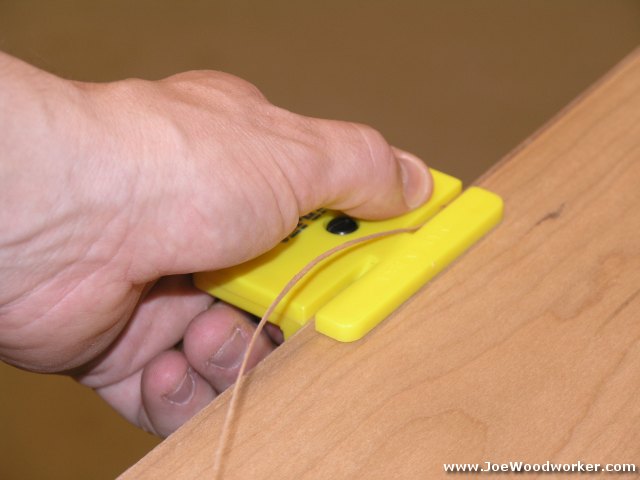
Edge banding is very easy to work with. The only tools required are a clothes iron and an edge-trimming tool. Any cheap clothes iron will work but I've found that the smaller travel size versions are the easiest to work with. For goodness sake, you might consider buying one instead of "borrowing" the one that your spouse uses to iron your Sunday best. There's nothing quite like the look of confused disgust when there is hotmelt glue coming off the iron and spreading onto a clean pair of pants... especially when you're already late for work or church!
Avoid this common mistake: do not seal the edges of the panel with shellac or any other coating. The hot-melt adhesive on edge banding adheres best to a porous and slightly roughened surface.
Getting Started
Cut a piece of edge banding about 1" longer than the length of the panel that you are banding. You can use scissors to cut it or simply fold it in half and it will snap apart. If you're planning to use a dye or any high-penetration stain, you'll want to pay attention to splice lines in the edge banding. These zig-zag lines occur randomly throughout the roll and are mostly invisible if you are only applying a clear coat but some dye stains can make them more visible.

If you are applying the edge banding to two joining sides, its best to work with the least visible side first. For example, if you are placing the edge banding around the four side edges of a rectangular piece of plywood, then start by edge banding the back side edge. Then move on to the left and right sides, and finish up by applying the banding to the front side of the material. This will help to hide the corner joints in an easy and eye-pleasing way.
Heat It Up!
 Turn on the clothes iron and set the temperature to the "high" or "cotton" setting. The ideal temperature is 390°F. Consider clamping the panel in a bench vise in the upright position so the clothes iron can be held horizontally. Start by placing the edge banding near one end of the panel and center it on the edge. The banding is slightly wider than the panel thickness so it is not critical that it is lined up perfectly with the edge. You can make minor adjustments to keep the banding straight as you go along. Turn on the clothes iron and set the temperature to the "high" or "cotton" setting. The ideal temperature is 390°F. Consider clamping the panel in a bench vise in the upright position so the clothes iron can be held horizontally. Start by placing the edge banding near one end of the panel and center it on the edge. The banding is slightly wider than the panel thickness so it is not critical that it is lined up perfectly with the edge. You can make minor adjustments to keep the banding straight as you go along.
Starting at one end of the banding and work towards the opposite end with the iron. Move the iron slowly along the banding while applying downward force. Keep your fingers away from the heat and exercise case to avoid getting stuck by splinters on the edges of the banding. The hot melt adhesive requires roughly 20 seconds of time under the hot iron. Some suppliers suggest pressing the edge banding in place for 20 seconds and then taking up the clothes iron and moving further down the edge and repeating the pressing. I don't think that is necessary or even ideal, so I press the iron down on the first section of banding and wait 10 seconds. Then I continue moving the iron along the edge slowly so that every inch of banding has been under the iron for about 20 seconds.
 You should be able to see a small bead of adhesive expand out from the underside of the banding if the adhesive is activating. To get the best bond possible, go over the edge banding with a block of wood or MDF (held at a 45° angle) immediately after each side of the panel is ironed down. For the most part, the hot melt adhesive can be worked for about 45 seconds after it has been heated. You should be able to see a small bead of adhesive expand out from the underside of the banding if the adhesive is activating. To get the best bond possible, go over the edge banding with a block of wood or MDF (held at a 45° angle) immediately after each side of the panel is ironed down. For the most part, the hot melt adhesive can be worked for about 45 seconds after it has been heated.
If the side edges of the banding lift slightly from the substrate, simply use the block of wood or MDF to press the edge back onto the substrate while the adhesive is still warm. You can also reheat the banding if needed.

Leaving the iron in one place too long can result in burning the edge banding so be certain to keep the iron moving.
If you are using a pre-finished edgebanding, place a cotton or flannel cloth over the edgebanding to prevent the heat from marring the finish. |
End Trimming
 To trim the ends of the banding, it's easiest to stand the panel with the banded edge against a workbench. Hold a 1" chisel tightly against the side edge of the panel and strike the chisel handle with a mallet. This should cleanly slice off any banding that overhangs. There are a few hand-held "end chopping" devices on the market. Don't waste your money on them. A chisel and a mallet are all you need. To trim the ends of the banding, it's easiest to stand the panel with the banded edge against a workbench. Hold a 1" chisel tightly against the side edge of the panel and strike the chisel handle with a mallet. This should cleanly slice off any banding that overhangs. There are a few hand-held "end chopping" devices on the market. Don't waste your money on them. A chisel and a mallet are all you need.
|