 |
 |
|
|
|

|
Part 1
|
There are times when a vacuum press just is not feasible for a project. Whether it's because the project is too big to fit inside a vacuum bag or too small to invest in a vacuum press, there are other ways to successfully veneer a project. Method 1: Weights and/or Clamps
If you are veneering a flat panel, you can get a good bond by simply using a cold press veneer glue on the substrate and placing a thick platen board on top with as much weight (tools, tool boxes, lumber, etc.) as possible over it. The platen board will help to distribute the weight evenly. It should be as large as the surface you are veneering. I recommend using at least a platen board of at least 3/4". In fact, two 3/4" platen boards are ideal. For small panels, a single 3/4" platen board and plenty of clamps around the edge will suffice. To keep the veneer and glue from sticking to the platens, place a sheet of wax paper between the platen face and the veneer. Keep in mind that this method of veneering requires a very flat veneer. Even if the veneer only has minor ripples in it, you probably need to flatten it first. For projects with curves or contours, you can place a pillow case filled half way with playground sand over the panel. Then flatten the top of this "sand bag" and place a board and some additional weight on top. I've seen this used on automotive dashboards and it appears to work fairly well. If you are using a standard cold press veneer glue such as X-Press™, then allow 45 to 60 minutes of clamping time before you remove the panel. It is critical that you allow the panel to dry properly. Click here for details about curing a veneered panel. For shop-sawn veneers that are more than 1/32" thick, use a PPR adhesive and clamp the project for 4 to 6 hours. When using weight to create clamping pressure on the veneer be aware that you will need plenty of it. For reference, a vacuum press is considered ideal for veneer work because it puts down 1,700 lbs of evenly distributed pressure per square foot. Most veneer adhesives require 1,300 lbs per square foot to get a good bond. This doesn't mean you must have this much weight to get a perfect panel. The idea is that more weight or clamping pressure will increase the chance that the panel will come out free of bubble and ripples. It's impossible to know the right amount of weight that is required to get a veneer to lay flat on the substrate. More weight is almost always better, and some veneers such as maple and bubinga require a more weight than most people can find to use for this purpose! There is also a great article about building a caul press in the September/October 1990 issue of American Woodworker magazine on page 30. It's and old artice, but a free download from Google. Method 2: Iron-On Veneering
Method 3: Contact Cement
Contact cement can be used on backed veneers only. It doesn't allow any repositioning of the veneer so you have to be careful with the placement of the sheet. You only get one chance to get it right. I haven't been a big fan of contact cement because the solvent based versions are too harmful and the water-based versions didn't seem to work very well. The good news is that there are now a few companies offering a decent water based contact cement. One of these is called Titan DX™ and it's available at VeneerSupplies.com. Solvent-based contact cement will also work over melamine and some plastic laminate substrates if it is scuff sanded with 80 grit first. Method 4: Flex-Pro Veneering
Method 5: PSA Veneer
Paper-backed veneers are available with a pressure sensitive adhesive (PSA). They are also called "peel and stick veneers", but industry veterans often call it pressure sensitive because it is sensitive to pressure. In other words, the more pressure you put on it, then better the bond strength. Simply peel off the wax paper backing, lay the veneer to the project panel, and press it down with a scraper tool (a roller will not provide enough pressure). PSA veneers stick best to lacquered, enameled, or varnished top-coated surfaces which are not peeling, cracking, or flaking and are free of dirt, dust, grime wax and grease. This is often said to be a great product to re-face kitchen cabinets! If your are veneering a porous surface such as drywall (yes, people do actually veneer over drywall), you can often apply two coats of shellac to the substrate and then get a very good bond from the PSA backer. PSA veneers can be an expensive route to take for veneering a lot surface area, but it is very convenient and quite easy. Method 6: Hide Glue Veneering
|





 This method has recently become very popular. It allows the user to veneer a panel with an ordinary clothes iron. With this method, raw wood and paper-backed veneers can be permanently bonded to flat and convex surfaces.
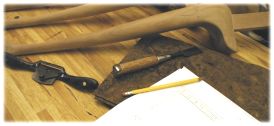
 Hide glue is perhaps the most traditional veneering adhesive. Its use dates back over 4,000 years ago to Egyptians who used it on furniture for the pharaohs. The application method is called hammer veneering, which derives its name from the use of a tool called a veneer hammer. The hammer is used press the veneer sheets onto the substrate. The method also requires a means of heating the glue typically in a double boiler. Hide glue is very durable and it can be re-heated and reactivated if bubbling or other issues occur during the application process.
 |
 |
|
 |
 |
 |